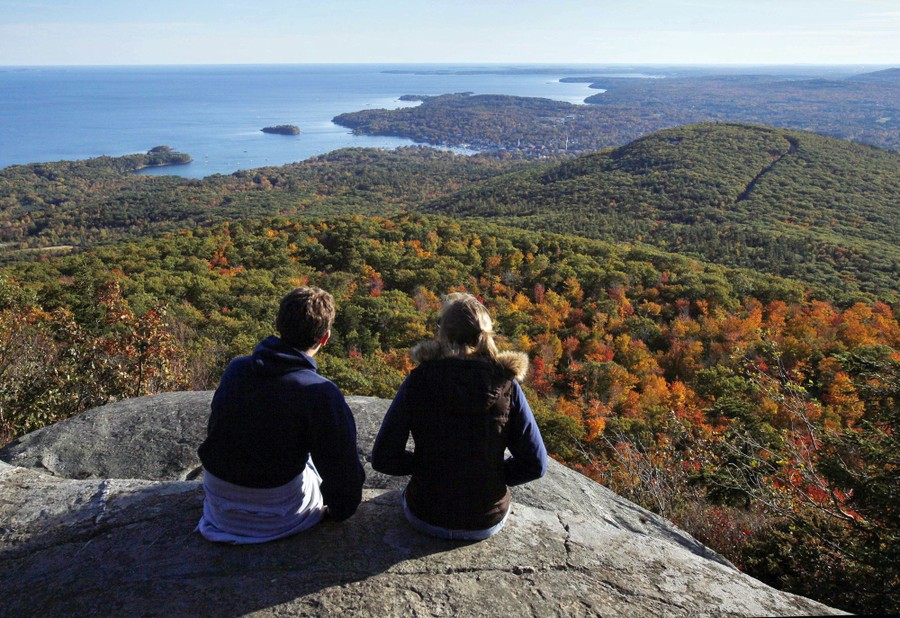
Small town moment in Friendship, Maine: Our lawn man toppled from his riding mower on a slope; couldn't get the big man up; called 911; two ambulances arrive. One of the EMTs hops on the mower, finishes cutting the lawn. pic.twitter.com/z5fGd8VrGW
Lobstering in Maine, unlike Canada and New Hampshire, is usually a single boat owned by a single license holder - with the number of licenses limited to 4,600 statewide. The typical boat is a two man crew (captain and sternman, occasionally a `third nerd') which sells its entire catch to a lobster wholesaler who sells him bait and fuel. Traps cost about $70 each with an 800 trap limit per boat. And then there's the boat. So they are small independent businesses with the Republican politics that generally go with that - including a reluctant embrace/resistance to the federal conservation measures that have shrunken (or conserved) the fisheries.
But the Trump years have been tumultuous - the tariffs imposed on China which reciprocated and the pandemic closure of restaurants have had a huge impact. - gwc
Maine Lobster: Which lobster fishing towns got the most Paycheck Protection Program money?
Maine lobster fishermen got 1,361 forgivable Paycheck Protection Program loans to offset the economic impacts of the COVID-19 pandemic. The amount of each loan is equal to about eight weeks of last year's wages. For many lobstermen, their wages are what's left over after making boat payments, paying crew and wharf fees and buying bait, fuel, and insurance.
While the PPP participation rate was high, many lobstermen lamented the lack of clear program guidelines. Some got rejected at the start because they were sole proprietors, and the application date for that group was later. Others balked when they were told different things about how they could use the forgivable loan so they wouldn’t have to repay it.
The sternmen and deckhands who work on the boat but do not own the business were initially left out of the PPP program, forced to apply on their own as independent contractors instead of being paid from the captain’s loan. That eventually changed, but only after most of the PPP money was spent. Most sternmen ended up on unemployment, according to banks that processed the loans.
This paper examines three facets of the breaking of major league baseball’s color line by Jackie Robinson of the Brooklyn Dodgers in 1947: the perception of blacks, the response of white players (whether teammates or opponents), and the reaction of baseball fans. By so doing, the paper will illuminate the fault-lines that characterized race relations within both the sport of baseball and the larger society as each was confronted with new challenges to long established policies and practices in the years after the Second World War.
July August Calendar Joyce Guppy
-
It looks like I forgot to do a calendar tribute at the start of July, given
all the commotion, so here’s a revisit of calendar pages for July and
August, s...
Bridgeville’s Bridge No. 1
-
Friday – photo by Mitch Waxman Recent endeavor found your humble narrator
casting shadows in Pennsylvania’s Bridgeville, part of the larger
Pittsburgh metr...
White Currant Sauce
-
[image: A plate of walleye with white currant sauce on a white tile
counter.]
A great white currant sauce that goes well with fish, chicken, any white
mea...
in dire straits
-
“Nothing untouched by war under the sun? Time for some flower power!”
sayeth Rembert. Indeed, there is nothing untouched by anything, for we are
all connec...
Sitka Nature Show #361 – Starling Birch (encore)
-
Download Radio Show The February 22nd show featured a conversation with
Starling Birch, videographer and mountain adventurer. Originally recorded
and aired...
#35 Vorder Grauspitz - Liechtenstein High Point
-
About a three hour drive west of Ehrwald and the Zugspitze, we arrived in
another ski resort village called Malbun, in the tiny country of
Liechtenstein....
Farewell to Looie
-
You thought I would omit the classic photo of Looie and John Thompson?
Photo: Queens Chronicle This was in a restaurant – Italian, I as I recall –
in Louis...
The America's Cup in Barcelona
-
I haven't posted for a long time, but it's blog anniversary day and I've
recently been in Barcelona where managed to see the America's Cup, so
thought...
MIDDLE SEA RACE 2009
-
The Middle Sea Race, one of the great 600 milers of ocean racing. I had the
great pleasure of sailing in 2009. Bugs Baer chartered a 61 foot (Nix) boat
for...
Hitching a Ride
-
At sea, sometimes birds find places to land on the boat and rest for a
while. Usually they land on the rail, which is easy to land on.
(Continued...)
Drilling Shaft Hole
-
Hi Everybody. First post here. I’ve been slowly building a Monaco. At the
point where i need to drill the shaft hole through the hull. I’ve seen a
number...
-
Nach langer Krankheit ist meine liebe Frau Martina sanft in meinen Armen
entschlafen. Mancher, der unseren Blog über die Jahre verfolgt hat, wird
vielleich...
-
Ahoy dear friends and fellow sailors! It's been far too long - but I am
happy to report we are still under sail (although currently on the hard in
Bridgew...
Red Dot on the Ocean
-
Matt’s life and voyage have been made into a feature-length documentary,
Red Dot on the Ocean. Learn how you can see it at RedDotontheOcean.com
The Vikings Have Landed!
-
The world’s largest Viking ship, Draken Harald Hårfagre, has arrived
in New York City, the grand finale of their long and epic expedition!
Draken Harald ...
Nearly Home Madame!
-
After the night of the big storm we pulled into Canso Bay, tucked behind
Madame Island in Lennox Channel. We found a great quiet anchorage to wait
out t...
Rumour has it…
-
Rumour has it that I was sailing this yacht last month on the Baltic Sea
and that they have started to build a very similar version for a third
attempt at ...
The End
-
After almost two months at sea and more than 5,000 miles, Issuma reached
Norfolk, Virginia. This was both my longest passage and my longest
singlehanded p...
Sea Chair – Art from A Plastic Ocean
-
Have a look at this beautiful video that speaks to the fact that the ocean
is full of all the consumer plastics we use that just Won’t. Go. Away!
These cle...
NRDC Defends California's Ivory Law in Court
-
Elly Pepper, Legislative Advocate, Washington, DC: Last year, California
became the third state in the country to pass legislation (Assembly Bill
96) restr...
DAY 71 | Making the call
-
[image: DAY 71 | An unmatched trilogy of Antarctic achievements]
The post DAY 71 | Making the call appeared first on Shackleton Solo.
Italian Travels
-
[image: Italian Travels]
A few photos of Barb, Bono, and Jim's adventures in Italy.
Date: Apr 2, 2015
Number of Photos in Album: 61
View Album
The Alexandra Shackleton on display at the ANMM
-
The Alexandra Shackleton (our James Caird replica) is now on display at the
Australian National Maritime Museum, taking pride of place in the foyer as
part...
Enjoying the Snow
-
A few weeks back I realized that we hadn't taken Fitz downhill skiing in
the backcountry at all. We've gone on tours in RMNP with Fitz in the
Chariot, but...
Star Island Shark Tournament Video
-
Here's the film debut of the Small Fortune from last month's Star Island
Shark Tournament. No winning fish this year but we're crossing our fingers
for...
No Particular Reason
-
I really have no reason to post this picture of two oranges and a red bowl
that I noticed on my kitchen counter the other day.
Except that it's half-way...
Northwest Passage 2012 - ARCTIC DREAMS Video
-
Looking back on 2012 hindsight is 20/20... ARCTIC DREAMS lead by Bob
Shepton aboard DODOS DELIGHT did an amazing 7,000 mile feat.... rather than
tell you ...
Design 90 - 76'-6" Shoal Draft Schooner
-
Only two drawings were prepared for this preliminary design proposal; a
Lines Plan and a Sail & Deck Plan. I believe the Lines Plan that is shown
here i...
-
Young Larry Blog - a continuation of Dermot's account of Young Larry's
transit of the Northwest Passage. We hope to up-date the blog at least once
a week....
The Home of KrazySailing
-
Attitude: the difference between an ordeal and an adventure! Passion trumps
Fears John (https://www.morganscloud.com) thinks it was Amundsen, the
incredibl...
Brooklyn Botanical Garden
-
Took a look around on a cold (free) day. Yeah, it’s free admission on most
weekdays through the winter!
There is a lot going on with plants during the cold ...
Broome Street no. 512-514, Manhattan.
-
New York Public Library posted a photo:
[image: Broome Street no. 512-514, Manhattan.]
Digital ID: 482849. Abbott, Berenice -- Photographer. October 07, ...