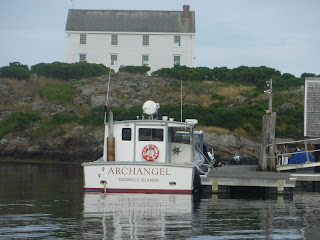
In 1605 George Weymouth headed to what we now call America. His ship, the Archangel, ran into the shallow waters of Cape cod Bay, turned east and sailed downwind until he hit Monhegan Island. They spent a night anchored in its inhospitable harbor, then found a cozy spot, now known as Georges Harbor, at the mouth of the St. George River and Muscongus Bay.. It is protected by four islands - a great refuge from the sea. They spent some time exploring the area, trading, kidnapping some natives, etc.
If you've ever visited us in Maine in fair weather you've been to the spot. Last summer, aboard Ralph and Hannah Wolf's Caleru, we replicated part of that voyage. We spent a peaceful night at Georges Harbor, anchored just off Andrew and Betsy Wyeth's place, near the granite cross the State of Maine placed in 1905 to mark the tercentennial.
Nestled in the Atlantic Ocean, five miles off the coast of the picturesque town of Port Clyde, Maine, lie two rugged islands with stories to tell. Allen and Benner, as they are called, have witnessed a string of inhabitants over the centuries, from the Abenaki people and English colonists to homesteading lobstermen. And then came Betsy and Andrew Wyeth — mid-coast Maine locals and the most high-profile members of what many consider the first family of American art.
After the death in 2020 at age 98 of Betsy James Wyeth, the notoriously formidable adviser, collaborator, business manager, muse, and wife of the realist painter Andrew Wyeth, a polarizing figure in American art history, the keys to the castle are now passing to a far younger generation. (He died in 2009 at 91.)
Colby College of Waterville, Maine, around 75 miles inland from the islands, is set to announce it has acquired Allen and Benner from the family’s two foundations, Up East and the Wyeth Foundation for American Art. The Colby connection could breathe new life into a name that has been lacking in youthfulness for some time.
At 76 I'm still so caught up in being a law professor, lawyer, Chinese student, and summer sailor that I'll probably never get to build a boat. But this would be a delight if I built it. Just my style. I could sail it on the Back River behind our house in Friendship, or trailer it anywhere.
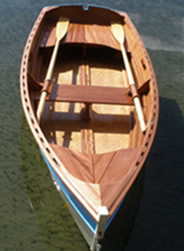
Sand Dollar is designed for the first-time builder, including those with no previous woodworking experience. She is a flat-bottomed skiff, with lapstrake sides. The bottom and sides are marine plywood, glued and screwed to a simple framework. As with the Penobscot 14, I took great pains with the lines, building a model to refine the shape. The result is a very pretty, practical little boat that will satisfy both the novice and experienced boat builder.
I included some innovations in the construction method, that made it possible to include some details that have the look of the craftsman's work, but which are really very easy to do. One is to install the seats before the side planking, which avoids having to cut them to fit inside the boat, as you would if they were installed later. I also developed very simple methods for cutting and fitting other parts that add so much to the boat's appearance.
Sand Dollar is a delight to build, and versatile on the water. She is a pleasure to row, and handles beautifully under sail. She is great for daysailing or fishing, and of course you can put a small outboard on the transom if you wish.
THE PLANS
I have tried hard to make the plans the most complete and detailed that you can buy. There are 15 sheets of drawings, including construction drawings, full size details, and sail plans, and a large sheet of full size patterns, showing the stem, transom, bulkheads, and building frames. This is printed on Mylar, which is very accurate, and stands up much better than paper to the rigors of workshop use. Being transparent also makes it easier than paper to use. There is also a complete building manual, illustrated with numerous drawings and photographs, which takes you step by step through the whole building process. It also includes a materials list and cutting schedule, a section on sharpening your tools, and sources for hardware you will need.
THE VIDEO/DVD
The two hour video/DVD takes you in great detail through each stage of building the boat. There are numerous close-ups, showing exactly how to get good results with some of the jobs that may be new to you. The video/DVD finishes with some great shots of the boat under sail and oar.
TOOLS, MATERIALS, COSTS, AND BUILDING TIME
You need a very basic set of woodworking tools to build Sand Dollar. These include a hand plane, a set of chisels, handsaw, and measuring tools. The essential power tools are an electric drill and a jigsaw. A list of necessary tools, with recommendations on which are most suitable, is given in the building manual.
During the last quarter of the 19th century and the beginning of the 20th century, Nathanael Greene Herreshoff designed some of the most complex, graceful, and ultimately successful racing and pleasure yachts in existence. Part of his genius was to also apply these same design skills to smaller and simpler craft such as the Fish class, the ubiquitous Buzzards Bay 121⁄2, and the object of my affection (and this discussion), the Biscayne Bay 14. Apparently, only about a dozen of these sailing skiffs (model 908) were ever produced by the Herreshoff Mfg. Co., all in the 1920s.
After retiring (for the first time) in 1998, I built a pair of Biscayne Bay 14s (BB14s): mine, named MR.BILL, and one for a friend. My habit of building two at a time came from my own apprenticeship in the 1970s with master craftsman Gary Kincaid. This approach spreads the costs, shares skills and space, and can offer you a willing companion for adventures after launching day. I recommend the concept of “building buddies.”
My decision to build a BB14 was based on its heritage, performance, low cost, and ease of transport. Another plus is the optional use of modern materials to create a strong hull that can be day-sailed directly from the back- yard to the water. The choice has proven to be a good one for me. During the past decade, MR. BILL has sailed waters ranging from the Gulf of Maine to Buzzards Bay.
Photo by Darin Carlucci
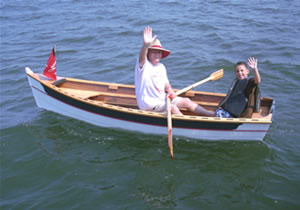
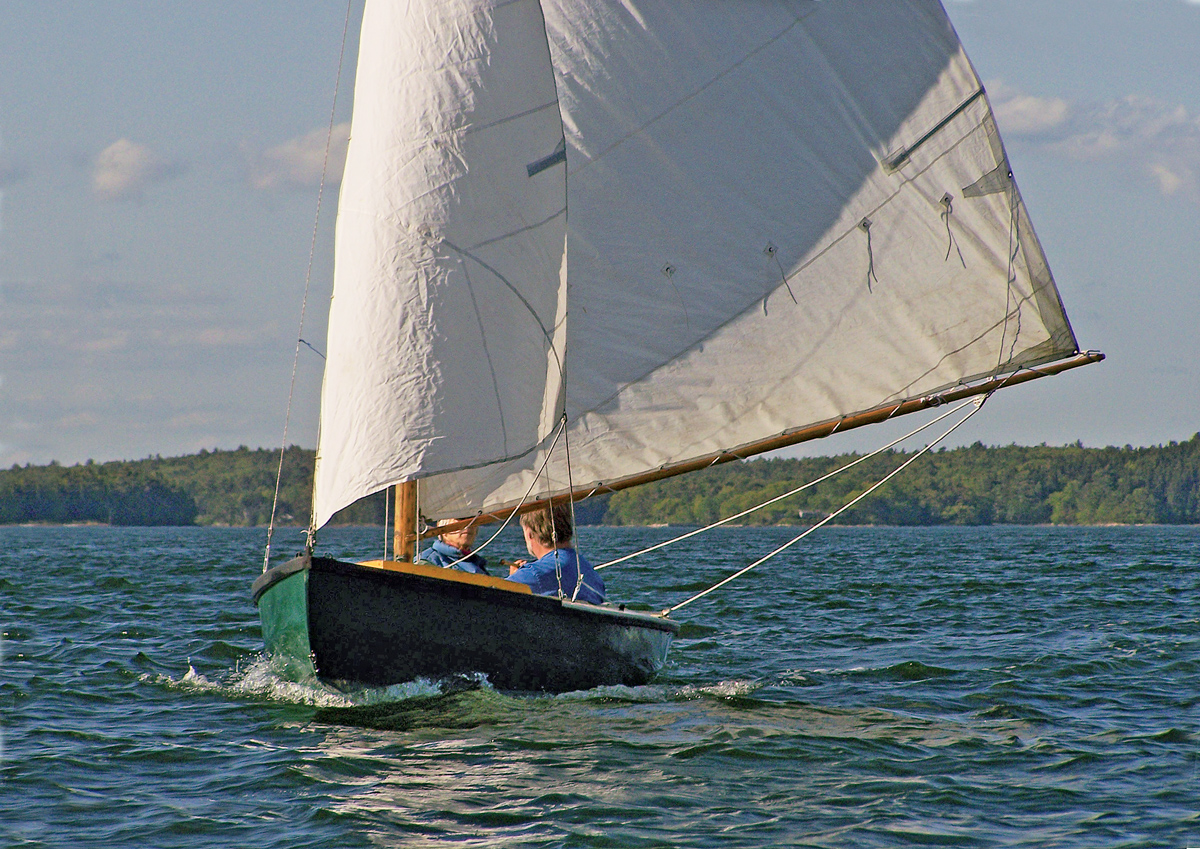
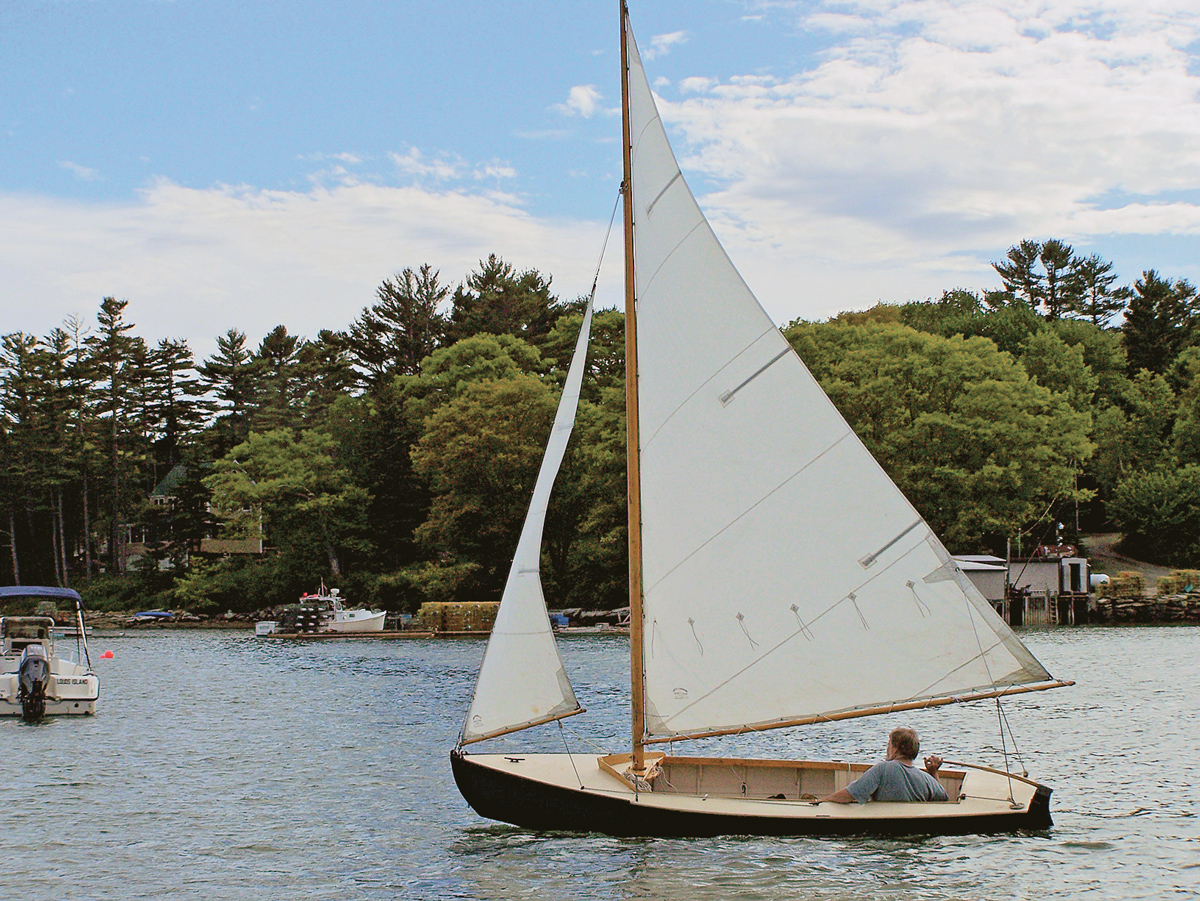
The Biscayne Bay 14, designed by N.G. Herreshoff, is a delightful, low-cost daysailer that transports easily and is a good performer. Jim Austin built his for exploring Muscongus Bay, Maine, with his wife, Darcy.
The plans for the BB14 as sold by WoodenBoat are complete and are backed up by an optional handbook taken from step-by-step construction articles, including lots of helpful photos. There is the choice to build the boat with a fixed keel, which would probably improve windward performance over the shallow keel/centerboard option that we chose. With the centerboard, MR. BILL nests snugly onto a small trailer for easy transport.
Although perfect as a singlehander, the BB14 often carries my wife as well as me over the waters of Maine’s Muscongus Bay, allowing us to explore the mouth of a small creek, run up on the beach for a picnic, or slide gracefully down the faces of ocean swells coming in past Monhegan. But don’t be fooled: this idyll comes at a price. The BB14s were designed for the warm, shallow waters of Florida, and there they will perform wonderfully. However, up in New England, you must pick your weather carefully and be prepared for a refreshing splash or two when beating to windward. I’ve added a V-shaped coaming forward of the mast to aid in deflecting the icy water before it reaches me or the cockpit. Since we chose the centerboard option, the next time I retire we could easily tow MR. BILL south to a place where the temperature more closely approximates our age.
Photo by Darin Carlucci
The Biscayne Bay 14 is a great design to build as plans indicate or to modify according to individual use.
Construction of the shallow keel with centerboard slot is challenging. The shape is well defined in the plans and a mold is not too difficult to build, but if you’ve never melted lead before, it could be a daunt- ing prospect and best left to a professional. For the rest of you pirates, there’s treasure in old chimney flashing, used tire weights, bits of plumbing—or an old, abandoned iron bathtub in which to melt all this material. The process of casting is well detailed in easily accessed articles and books (see WB No. 89).
The hollow mast is fun to build as described in the plans. I used carefully chosen and dried lumberyard spruce 2×4s, 2×6s, and 2×8s, as they make a strong, light-weight stick, which has never failed me in years of hard use. There are other spar-building techniques such as “bird’s mouth” (see WB No. 149) that can be used if you love more complex geometry.
The BB14 design calls for a watertight compartment forward of the mast. As a longtime builder, I dislike parts of a boat that are inaccessible. As a long-time sailor, though, I love the idea of flotation in small boats. My solution was to create a space under the foredeck with an opening and an air bag. The bag can be inflated during use, and deflated and removed for inspection and maintenance. I keep a small picnic anchor and rode in the same space, which helps add a little weight forward to keep her nose in the water when going to windward.
To build my BB14, I used marine-grade Okoume plywood, local oak and spruce, bronze fastenings, and epoxy. My favorite tool for cutting plywood is a 31⁄2″ 9V-battery-powered circular saw outfitted with a plywood blade (for a thin kerf). The saw’s lightweight makes it quite handy, although you may want a backup battery for extended cutting. Finish was mostly marine paint with some show-off varnish on spars and coamings. All these materials have held up well with proper annual maintenance.
July August Calendar Joyce Guppy
-
It looks like I forgot to do a calendar tribute at the start of July, given
all the commotion, so here’s a revisit of calendar pages for July and
August, s...
Bridgeville’s Bridge No. 1
-
Friday – photo by Mitch Waxman Recent endeavor found your humble narrator
casting shadows in Pennsylvania’s Bridgeville, part of the larger
Pittsburgh metr...
White Currant Sauce
-
[image: A plate of walleye with white currant sauce on a white tile
counter.]
A great white currant sauce that goes well with fish, chicken, any white
mea...
in dire straits
-
“Nothing untouched by war under the sun? Time for some flower power!”
sayeth Rembert. Indeed, there is nothing untouched by anything, for we are
all connec...
Sitka Nature Show #361 – Starling Birch (encore)
-
Download Radio Show The February 22nd show featured a conversation with
Starling Birch, videographer and mountain adventurer. Originally recorded
and aired...
#35 Vorder Grauspitz - Liechtenstein High Point
-
About a three hour drive west of Ehrwald and the Zugspitze, we arrived in
another ski resort village called Malbun, in the tiny country of
Liechtenstein....
Farewell to Looie
-
You thought I would omit the classic photo of Looie and John Thompson?
Photo: Queens Chronicle This was in a restaurant – Italian, I as I recall –
in Louis...
The America's Cup in Barcelona
-
I haven't posted for a long time, but it's blog anniversary day and I've
recently been in Barcelona where managed to see the America's Cup, so
thought...
MIDDLE SEA RACE 2009
-
The Middle Sea Race, one of the great 600 milers of ocean racing. I had the
great pleasure of sailing in 2009. Bugs Baer chartered a 61 foot (Nix) boat
for...
Hitching a Ride
-
At sea, sometimes birds find places to land on the boat and rest for a
while. Usually they land on the rail, which is easy to land on.
(Continued...)
Drilling Shaft Hole
-
Hi Everybody. First post here. I’ve been slowly building a Monaco. At the
point where i need to drill the shaft hole through the hull. I’ve seen a
number...
-
Nach langer Krankheit ist meine liebe Frau Martina sanft in meinen Armen
entschlafen. Mancher, der unseren Blog über die Jahre verfolgt hat, wird
vielleich...
-
Ahoy dear friends and fellow sailors! It's been far too long - but I am
happy to report we are still under sail (although currently on the hard in
Bridgew...
Red Dot on the Ocean
-
Matt’s life and voyage have been made into a feature-length documentary,
Red Dot on the Ocean. Learn how you can see it at RedDotontheOcean.com
The Vikings Have Landed!
-
The world’s largest Viking ship, Draken Harald Hårfagre, has arrived
in New York City, the grand finale of their long and epic expedition!
Draken Harald ...
Nearly Home Madame!
-
After the night of the big storm we pulled into Canso Bay, tucked behind
Madame Island in Lennox Channel. We found a great quiet anchorage to wait
out t...
Rumour has it…
-
Rumour has it that I was sailing this yacht last month on the Baltic Sea
and that they have started to build a very similar version for a third
attempt at ...
The End
-
After almost two months at sea and more than 5,000 miles, Issuma reached
Norfolk, Virginia. This was both my longest passage and my longest
singlehanded p...
Sea Chair – Art from A Plastic Ocean
-
Have a look at this beautiful video that speaks to the fact that the ocean
is full of all the consumer plastics we use that just Won’t. Go. Away!
These cle...
NRDC Defends California's Ivory Law in Court
-
Elly Pepper, Legislative Advocate, Washington, DC: Last year, California
became the third state in the country to pass legislation (Assembly Bill
96) restr...
DAY 71 | Making the call
-
[image: DAY 71 | An unmatched trilogy of Antarctic achievements]
The post DAY 71 | Making the call appeared first on Shackleton Solo.
Italian Travels
-
[image: Italian Travels]
A few photos of Barb, Bono, and Jim's adventures in Italy.
Date: Apr 2, 2015
Number of Photos in Album: 61
View Album
The Alexandra Shackleton on display at the ANMM
-
The Alexandra Shackleton (our James Caird replica) is now on display at the
Australian National Maritime Museum, taking pride of place in the foyer as
part...
Enjoying the Snow
-
A few weeks back I realized that we hadn't taken Fitz downhill skiing in
the backcountry at all. We've gone on tours in RMNP with Fitz in the
Chariot, but...
Star Island Shark Tournament Video
-
Here's the film debut of the Small Fortune from last month's Star Island
Shark Tournament. No winning fish this year but we're crossing our fingers
for...
No Particular Reason
-
I really have no reason to post this picture of two oranges and a red bowl
that I noticed on my kitchen counter the other day.
Except that it's half-way...
Northwest Passage 2012 - ARCTIC DREAMS Video
-
Looking back on 2012 hindsight is 20/20... ARCTIC DREAMS lead by Bob
Shepton aboard DODOS DELIGHT did an amazing 7,000 mile feat.... rather than
tell you ...
Design 90 - 76'-6" Shoal Draft Schooner
-
Only two drawings were prepared for this preliminary design proposal; a
Lines Plan and a Sail & Deck Plan. I believe the Lines Plan that is shown
here i...
-
Young Larry Blog - a continuation of Dermot's account of Young Larry's
transit of the Northwest Passage. We hope to up-date the blog at least once
a week....
The Home of KrazySailing
-
Attitude: the difference between an ordeal and an adventure! Passion trumps
Fears John (https://www.morganscloud.com) thinks it was Amundsen, the
incredibl...
Brooklyn Botanical Garden
-
Took a look around on a cold (free) day. Yeah, it’s free admission on most
weekdays through the winter!
There is a lot going on with plants during the cold ...
Broome Street no. 512-514, Manhattan.
-
New York Public Library posted a photo:
[image: Broome Street no. 512-514, Manhattan.]
Digital ID: 482849. Abbott, Berenice -- Photographer. October 07, ...