Tuesday, May 3, 2022

Lobster groups mount uncertain First Circuit fight on fishery’s future | Courthouse News Service


Lobster groups mount uncertain First Circuit fight on fishery’s future | Courthouse News Service


BOSTON (CN) — Arguing before a skeptical First Circuit, an attorney representing a group of Maine lobster fishermen said a federal rule designed to protect the endangered North Atlantic right whale targets a portion of the ocean where there are no right whales.

“We need to figure out where the whales are and target those areas,” said attorney Alfred Frawley IV at oral arguments Tuesday before the federal appeals court in Boston.

But the First Circuit appeared to give Frawley a frosty reception, saying at one point that the record lacked evidence that the seasonal closure would lead to lost lobster boats and jobs across the coast of Maine.

The National Marine Fisheries Service issued the rule at issue in 2021, closing a 967-square-mile strip of ocean off the coast of Maine to the use of vertical line buoys, a method of fishing most common with lobster fishermen, between the months of October and January.

Regulators say the move is meant to protect the endangered North Atlantic right whale, whose population is hovering at about 336. One of the biggest threats to the animal is entanglements, with some of the most common entanglements involving lines and buoys.

Though the fishermen have secured a temporary restraining order from a federal judge, a three-judge panel of the First Circuit unanimously blocked that order in November, allowing the seasonal closures to take effect pending the government’s appeal.

Perhaps even more worrying for the lobster industry, however, was the panel’s mention in that ruling that the National Marine Fisheries Service could ultimately prevail on its seasonal closure of that area off the coast of Maine.

“As we have explained, it is likely that the Agency ruling at issue here will be sustained given the deference that a court must accord to executive agencies carrying out congressional mandates,” U.S. Circuit Judge William Kayatta Jr. wrote for the panel in November.

Along with Judge Gustavo Gelpi Jr., who was also on the November panel, Kayatta was joined Tuesday by Judge Sandra Lynch for the latest round of oral arguments.

Frawley argued the National Marine Fisheries Service rested solely on speculation in closing the strip of ocean — a move that he said could leave lobster fishermen losing out on 4 million pounds of catch. He had asked the government to do acoustic recordings, aerial surveys and more testing to better locate right whale habitats.

Lynch asked Frawley if he had approached attorneys for the Marine Fisheries Service to see if they would work out a way to get more information about what was happening in the ocean.

Frawley began to make two points, but Lynch cut him off: “Will you answer my question rather than making a speech?” the Clinton appointee said.

Frawley then said his clients were not allowed to sit on the take-reduction team.

The Atlantic Large Whale Take Reduction Team, made up of industry groups, conservation groups and state officials, is a group that seeks to reduce the harm to whales caused by fishing gear.

Sunday, April 24, 2022

A Portrait of South Georgia: Abundance, Exploitation, Recovery - The New York Times


It is the cold waters that are rich with plant life, and the big mammals and birds that made the Southern Ocean - the waters around Antarctica - the richest hunting grounds for whalers.  The one port on South Georgia, the 1,367 square mile island nine hundred miles east of Cape Horn, is Grytviken.  It is most famous as the place from which Amundsen embarked for the South Pole, and  Ernest Shackleton in 1914  shoved off for two years stranded in the ice pack.  And to which he returned in the legendary 900 miles small boat journey from Elephant Island at the tip of the Antarctic peninsula.
My friend Richard Hudson stopped there aboard Issuma on his way to Capetown from the Antarctic.
There he met Sally Poncet who lives and studies on the island.

Richard tells me 
Sally Poncet.  I met her when I was in
Grytviken--she was counting wildlife.  I seem to recall her
half-jokingly telling me I had too much stuff (dinghy, liferaft,
spinnaker poles, fisherman sail) stored on deck.  As I think you know,
my boat (a Damien II), is a copy of the sailboat that she wintered in
Antarctica on, so she's definitely someone I'd listen to (though I still
have all that stuff stored on deck :)  

- GWC 

 A Portrait of South Georgia: Abundance, Exploitation, Recovery - The New York Times


John Harvey, MP, Merchant Mariner remembered on the centenary of his birth

 My old friend Richard Harvey - a socialist Barrister - who played a key role in the Bloody Sunday inquiry, remembers his father, a Derryman, Merchant Mariner, and Conservative MP. 

Asked later how he dealt with the risk of being torpedoed, he said: “if we were carrying iron ore, we slept fully clothed and in our life jackets. If the hold was full of explosives, we put on our pyjamas. No point in worrying.” Fortunately, when his ship was torpedoed in 1942 it was not carrying explosives and, after three days clinging to an overcrowded raft in the Indian ocean, he and his fellow seamen were rescued.


100 years ago today in Derry my father drew first breath. Though he and his family left at the height of the 1920s Troubles, he took lasting memories with him; of walking the City Walls with his parents and of outings on the River Foyle with the Sea Cadets his father ran. In 2000 I moved to Derry for the Bloody Sunday Inquiry. One day I called him just as the Guildhall clock bonged at noon. “Hah, haven’t heard that for 80 years,” he said.
His Scottish father was in the first wave sent to Flanders in 1914. He survived the Somme but was invalided back to London after Mons. He was nursed by an East End girl from Poplar, whom he married. They ran Missions to Seamen hostels, first in Wales, then Derry, then a travel agency sent my grandfather back to Belgium to give English families tours of the beautiful city of Bruges, the beaches of Ostend and the battlefields of the Great War.
In Bruges, my father was taught by French-speaking nuns. His first day, being an inquisitive child, he found a small porcelain pot on his desk, filled with a mysterious dark substance. His hands covered in indelible ink, he was banished to the school chapel to repent his wicked ways. Still curious, he saw a rope dangling from the ceiling. A tug, and the school bell pealed out. The priest in charge drummed into him the urgency of learning French.
With the Great Crash, the family moved back to England and ran the Workers’ Travel Association’s trade union holiday home in Dorset. At Lyme Regis grammar school he met Joyce Lane. When he became Head Boy and she Head Girl, she refused to let him take himself too seriously; when he pinned announcements on the school notice-board she drew stick men on them, to the amusement of the headmaster, if not the head boy.
He won a place at university but, as so often in those days, his parents couldn’t afford the fees. So, when war came, he remembered the visits to the WWI battlefields with his father: the grisly detritus still sticking out of the ground – helmets, even bones. He enlisted in the Merchant Navy so he could play his part against fascism without having to carry a gun. He took a crash course to become a radio officer. What he saw of the world, from New York to Durban, from Calcutta to Sidney, left him with a profound concern for equality and human dignity and an interest in international affairs that lasted until his final days.
Asked later how he dealt with the risk of being torpedoed, he said: “if we were carrying iron ore, we slept fully clothed and in our life jackets. If the hold was full of explosives, we put on our pyjamas. No point in worrying.” Fortunately, when his ship was torpedoed in 1942 it was not carrying explosives and, after three days clinging to an overcrowded raft in the Indian ocean, he and his fellow seamen were rescued.
He was demobbed on 15th November 1945. Two days later he and Joyce married in Lyme Regis. He had no job, no university degree and his work experience was limited to just five years at sea. But he never doubted his own abilities and he had a remarkable way of persuading others to trust them too. If he’d been a lawyer, he would never have lost a case!
Starting as a trainee in a company supplying lubricants to shipping lines, he became its general manager in a few years. Living in Churchill’s constituency, he threw himself into Conservative Party politics. He was never afraid to disagree with party leadership or even with Churchill the first time they met. “Come on, Harvey, we must have a talk,” said Churchill and steered him into his library to discuss foreign policy. The 27 year-old must have made an impression on the 73 year-old because when someone attempted to introduce them again weeks later, Churchill said: “You don’t have to introduce me to Harvey, we’re old friends, aren’t we Harvey?”
As Chairman of Churchill’s constituency party, Harvey was summoned to 10 Downing Street on April 6, 1955. Churchill took his customary seat in the Cabinet Office, beckoning my father to sit on his left. He showed him a copy of his letter of resignation to the Queen. Signing it, he said: “There are only two people to whom I have written such a letter; to my Sovereign as representing the Nation and to you as representing my constituents.”
The following month, John Harvey was elected MP for Walthamstow East, a seat he held through the elections of 1959 and, by the tiniest of margins, in 1964. He refused offers of junior ministry posts, preferring the security of his day job in the oil industry. In 1966, when Labour won Walthamstow, he left the business of politics and continued in the politics of business, serving as public affairs director on the board of Burmah Castrol, together with Dennis Thatcher – of whom he was much fonder than he was of Mrs T.
His own political philosophy was perhaps best summed up on the 50th anniversary of Churchill’s appointment as Prime Minister. “There is no handbook of Conservative dogma,” he said: “The fundamental aim of conservatism is to conserve all that is best out of the past and to use it constructively in the present for the benefit of the future.”
He cared passionately about conserving Epping Forest, which he served as a verderer for 28 years, determined to maintain its original acreage against the encroachments of developer and road builder. After 51 years of their very loving marriage, Joyce died in 2007. He followed a year later.
He managed every little detail of his life and tried hard to manage mine. He needed to be sure I could work the ancient Amstrad which he used to write his carefully crafted letters and keep meticulous accounts. He was a very public man but very private too; he shared the secrets of his filing cabinet but never told me of his poems or his young man’s dreams, shut in a dusty briefcase for me to find when he had gone. He kept his feelings close. We shook hands awkwardly until his last decade, when suddenly he opened to embrace and we would kiss each other’s weekend-stubbled cheeks and say those strange words: I love you.

Monday, April 18, 2022

A Portrait of South Georgia: Abundance, Exploitation, Recovery - The New York Times


A Portrait of South Georgia: Abundance, Exploitation, Recovery - The New York Times


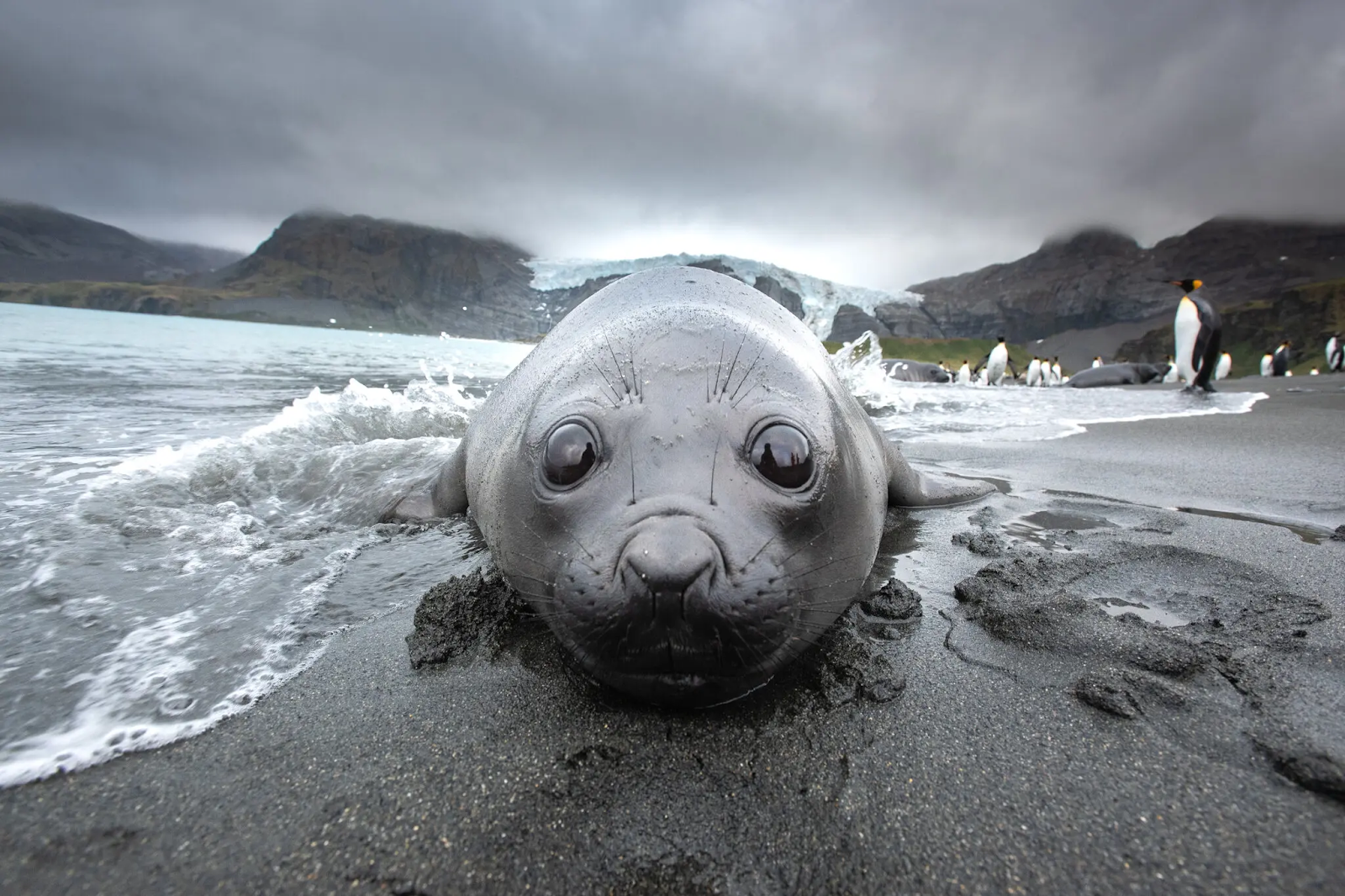
Sally Poncet first came to South Georgia in 1977. Back then, she said, the sub-Antarctic island was as gorgeous as it is today: A spine of mountains, some 100 miles long, defines the terrain; glaciers drape down from the peaks, with verdant slopes running up to meet them; glistening beaches wrap around the shoreline. But in those days, Ms. Poncet recalled, the island had an empty feel to it. “You felt a lack,” she explained. “It wasn’t alive like you knew it could be.”

Nobody knows South Georgia the way Ms. Poncet does. An independent field ecologist, she has surveyed or counted everything from its grasses and albatrosses to its elephant seals. Her second son was born on a sailboat here in 1979. Now, at the age of 69, she continues to work in the field — just as she did 45 years ago.

One result of these changes is a soundscape replete with squeaking, barking, belching, groaning and growling.

“Seals are calling everywhere,” said Ms. Poncet., “It’s constant — absolutely constant noise.”

Counting whales and understanding their habits can be an arduous task, but Jen Jackson, a whale biologist with the British Antarctic Survey, is working on it. Dr. Jackson’s research methods include professional observers, biopsy darts, fecal samples, droplets of whale breath, acoustic detectors and satellite tags. Using historical catch counts and new scientific data, her team has concluded that humpbacks are back to their pre-whaling numbers; there are 24,500 of them in the Scotia Sea, which surrounds South Georgia.

Ridding the island of the invasive land mammals — reindeer, rats and mice — required a monumental effort and over $13 million, but the payoff for wildlife has been extraordinary. During the summer of 2013, teams that included both Indigenous Sámi reindeer herders and Norwegian marksmen came to eradicate a reindeer population of 6,700 animals. The marksmen returned in 2014; they were so efficient that for every 10 animals they killed, they used just 11 bullets. By 2015, the island was free of reindeer.

The pipits poured in from rat-free areas so fast that scientists didn’t have time to document their recovery. Because these birds can lay four clutches of between three and five eggs per year, their numbers grew in a flash. Meanwhile, those living at the main British Antarctic Survey station found themselves watching large rafts of pintail ducks in the harbor during wintertime, and flushing pipits and pintails from the tussac grass during spring.

“It was like Grytviken was haunted by pintails,” said Jamie Coleman, a biologist who has spent three years on South Georgia. “You could constantly hear their whistling throughout the buildings.”


Saturday, April 16, 2022

Natchez Trace Ol' 55


Sunday, April 10, 2022

US Sailing Team takes silver and gold in Mallorca, Spain


The 51st Princesa Sofia tournament took place last week in Mallorca, Spain. The US. Sailing team took a silver and a gold.  These photos capture the excitement and athleticism of Olympic class racing today.


Thursday, March 31, 2022

Van Morrison: Playhouse, Edinburgh


Van Morrison: Playhouse, Edinburgh

Van Morrison
Edinburgh Playhouse
Wednesday 23 March 2022

Van Morrison brings his mercurial talents to Edinburgh with a typically soaring set of stone-cold classics. Sam Lambeth reviews.

Van the Man? To paraphrase Peep Show, it should be ‘Ven the Men’. For tonight isn’t just about the Belfast balladeer. Over the course of nearly two hours, Van Morrison’s band are the gears and the glue, driving the singer’s bull seal bellow forward with creativity, majesty and melody.

It’s testament to their ability and their enthusiasm that when the closing Gloria – a ’60s smash for Van’s first band Them – hits a solid instrumental groove, Morrison leaves the stage a good ten minutes before the song is over and the audience does not bat an eyelid.

As they did when LTW last caught Van the Man live in 2021, each musician has ample time to showcase their significant talents, whether it be a driving guitar solo, complex keyboard parts or an electrifying stab at the xylophone.

The thought of a significant amount of stage time without Van Morrison would have seemed unthinkable for anyone attending their first concert by the blue-eyed soul stirrer, but throughout the night his band show they are some of the handiest hired guns in town.

Take the soaring solo his fine backing vocalist takes on during the epic Sometimes We Cry – whereby a rowdy fan commits a crazy novelty by almost, almost making Van chuckle during the song’s lengthy breakdown – or the dextrous guitar solos that accompany the rambunctious cover of Laughin’ and Clownin’. Morrison himself shows he has another ace up his sleeve besides his voice, performing taut and dextrous blasts of saxophone during the contemplative classic Days Like This and the jaunty Caledonia Swing. Van the Vessel would also be a more appropriate nickname, for throughout the course of the show, the songs – and that voice – seem to flow through Morrison like an act of divine intervention.

As a frontman, he is a stoic and silent figure. The only movement comes from his gesticulated thumps of the air during a crescendo or his adjustment of his music stand. Dressed in his usual uniform of natty blue suit and aviator shades, a shock of red hair poking through his ever-present trilby, Morrison resembles an ageing boulevardier rather than a Rock & Roll Hall of Famer.

However, when he opens his mouth to sing, something truly transcendental happens. At 76, he still possesses a powerful, stirring set of pipes that are able to demonstrate bluesy menace or soulful sorrow with equal aplomb.

His most recent album, the glibly titled Latest Record Project Volume One, demonstrates Morrison’s commitment to the craft of songwriting is admirably workmanlike, but also remarkably consistent. For example, the groove of Double Agent slots in seamlessly amongst The songs lifted from his flawless Moondance album – the uplifting These Dreams of You and the wistful And It Stoned Me – possess the same verve, beauty and charm as they did when released in 1970, but this time there is added punch and poignancy from the thumping guitars, strident sax and epic harmonies.

Brown-Eyed Girl remains Morrison’s touchstone, and its youthful pomp gets most of the seated crowd up on their feet. As the Northern Irishman bows his goodbye, he leaves the stage while still singing. It’s a fitting representation of the devotion Morrison has for his craft.

For the latest Van Morrison tour dates, please visit his website


Monday, March 14, 2022

Spring break 2022

Martian valley -