Hank Mobley tenor sax
Kenny Drew piano
Niels Henning Orsted Pedersen bass
Albert Tootie Heath drums
Hank Mobley tenor sax
Kenny Drew piano
Niels Henning Orsted Pedersen bass
Albert Tootie Heath drums

 |
| The Tercentennial granite cross at Allen Island |


When Henry Hudson sailed into New York City in 1609, he happened upon one of the world’s most impressive natural harbors. There, Hudson saw whales, otters, turtles, and countless fish. What he could not have seen, however, were the 220,000 acres of oyster beds below the surface on the harbor floor, constituting nearly half of the oysters in the entire world.
The local Lenape, who would open the oyster shells by wrapping the entire oyster in seaweed before tossing them in fire, introduced the ensuing wave of European visitors to Manhattan to the pleasures of oyster consumption. The Dutch, like the English and others who subsequently made their way to New York, loved the tasty bivalves. Oysters quickly became synonymous with New York City, as Mark Kurlansky’s book, The Big Oyster: History on the Half Shell, skillfully outlines. Long before hot dog carts could be found everywhere, oysters were the ubiquitous food items of New York City; the original street meat.
It seemed everywhere an enterprising fisherman looked, they found abundant oyster beds, from outer Long Island to Raritan Bay to Norwalk, Connecticut. In fact, oysters routinely grew to the size of dinner plates in the present-day Gowanus Canal. (And that’s a sentence that gets more disgusting the longer you read it). A first-person account by a Dutch missionary named Jasper Danckaerts recounted in the book Gowanus: Brooklyn’s Curious Canal, describes Gowanus oysters in 1679 as “large and full, some of them not less than a foot long, and they grow sometimes ten, twelve and sixteen together, and are then like a piece of rock.”
Everyone in New York ate oysters. The rich saw them as a delicacy, and the poor enjoyed how cheap they were and not to mention, how easy they were to collect. Oyster taverns popped up all over the city to feed the seemingly insatiable appetite. But, of course, this pace could not endure, and soon the oyster populations faced a multi-pronged threat to their existence.
Firstly, they were over-harvested. Too many people were eating too many oysters. When the oyster beds around Staten Island became depleted in 1820, the status of oysters around New York took a turn for the worse. Undeterred by this harbinger of things to come, New York continued to harvest oysters at an even greater pace. By the early 1900s, over 1 billion oysters a year were being pulled out of the area’s waterways.
Another major threat to the oyster beds was the city’s ever-expanding shoreline. Between 1609 and 2010, Manhattan grew by roughly 20%. What was once a shoreline of marshy, rocky shallows — an ideal environment for oyster beds — had been replaced with a nearly unbroken string of bulkheads, piers, and landfill. It was good for trade and commerce, but bad for marine biodiversity.Lastly, waste management, or the lack thereof, contributed to the oyster’s demise. Until circa the 1970s, New York was dumping millions of gallons of raw, untreated sewage into the harbor on a daily basis. (Today, the city’s combined sewer system still ejects sewage with stormwater during peak flow). Not surprisingly, the oyster beds could not survive. Due to fears of food-borne illness, including typhoid, the New York City Health Department closed the Jamaica Bay oyster beds in 1921, which were responsible for 80 million oysters a year. From there, oyster bed closures spread across the city quickly: six years later, in 1927, the last New York City oyster bed was closed in Raritan Bay.
With the passage of the Clean Water Act fifty years later in 1972, the harbor was given minor respite, but it was too little and too late. New York City oysters would survive as a species, but they would not be fit to eat again any time soon. And just like that, New York City had squandered one of its greatest natural resources, by imposing upon their habitat, over-harvesting their population, and dumping sewage on all that remained.
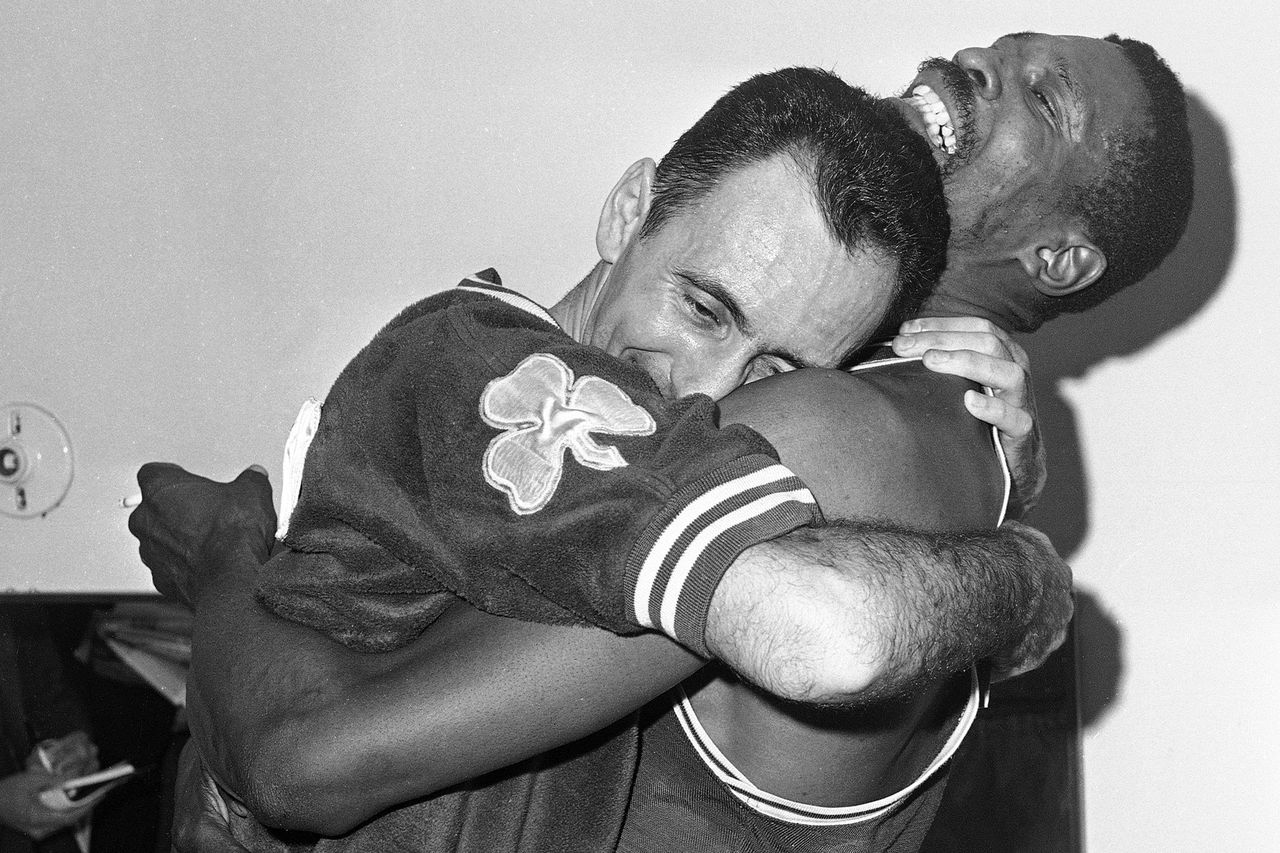
In 1963 I came by my affection for the Boston Celtics in a pretty typical tribal way. A freshman New Yorker in New England - at Holy Cross - the alma mater of greats Bob Cousy and Tom Heinsohn. The Celts had won another championship - over LA. The string of 9 in 11 years -had begun when Bill Russell, fresh off 1956 Olympic gold, joined the team as a rookie. And the winning kept coming until 1968-1969 when Russell retired as player coach. - GWC
"He fought the good fight" Celtics Greats: Bob Cousy Remembers Bill Russell
By Dan Shaughnessy//Boston Globe - July 31, 2022


They had Hall of Fame players and a Hall of Fame coach, and the Celtics were champions every year, it seemed. They won eight consecutive NBA titles in Red Auerbach’s last eight years as coach. They won 11 championships in 13 seasons between 1957–69.
And the one and only constant was Bill Russell. The man in the middle. The greatest winner in team sports history.
Russell died Sunday at the age of 88.
We’ve been losing these fabled champs with somber regularity the last four years. Frank Ramsey died in 2018. John Havlicek in 2019, Tommy Heinsohn and K.C. Jones in 2020, then seven months ago (just before New Year’s), Sam Jones. Hall of Famers, one and all.
Now, Russell. The giant of giants. The greatest of the greats.
Bob Cousy, who played with all of the above and won six championships in seven seasons with Russell, was with his daughter Marie and recovering from a kidney stone when he got the news early Sunday afternoon.
“My old friend, Russ, beat me to it,” said Cousy, days shy of his 94th birthday (Aug. 9) and on the receiving end of many sad calls lately. “He got there first. I got a hunch I’m going to be seeing him shortly. I don’t want to be morbid, but I’m not signing up for the marathon these days. At 88, I suppose we expect it.
“Russell goes down as the best winner ever in American team sports. That’s pretty significant and that’s never going to change. He fought the good fight, obviously, on the floor, but he fought the good fight off the floor, fighting racism all his life. Sticking his tongue out at the opponent. That’s not easy to do.
“People give up things to take a stand, and Russell simply never cared. Jocks generally worry about their image after they’ve had a successful career and they’re all very careful as to what they say and how they approach every issue. Most of them are very circumspect and have people that advise them. Russell just let it flow. He spoke out against racism in every form and I’m sure he’s happier for that now.”
Cousy was a six-year veteran and an established NBA superstar when Russell joined the Celtics after winning Olympic gold in 1956. The early ′50s Celts were perennial contenders, but were not able to win a championship until Russell came on board.
They won it all in his rookie season — Cousy was league Most Valuable Player as well — and never stopped winning until Russell retired, when Red shocked the sports world by naming him the first Black head coach in major US sports history. Russell won his final two banners as player-coach in 1968 and ‘69, then walked away.
“In my judgement, Boston doesn’t make enough of what that group accomplished in the ‘50s and ‘60s. It’s something that will never be done again in American team sports. It’s spectacular and singular,” said Cousy. “Eleven championships in 13 years. Given what teams go through to win a Stanley Cup or a World Series or Super Bowl, they do it twice and they burn down cities and celebrate all week. We did it 11 times in 13 years and Russ is the center point of that.
“We had eight Hall of Famers and, despite what (J.J.) Redick thinks of players from that time being firefighters or plumbers, the competition was tough. Today’s jock is better, bigger, stronger. Of course they are. But whatever the skill level was in the ‘50s and ‘60s, when it was more concentrated [with fewer teams], that made it more difficult to win. Eleven out of 13, and it should have been 12 if Russ doesn’t stub his toe against St. Louis in 1958. He’s the cornerstone.”
Cousy retired in 1963. He spent the ensuing decades wondering why the two were never particularly close, and put his thoughts into a book, “The Last Pass,” with author Gary Pomerantz in 2018. Like many in Boston, Cousy last saw Russell at a memorial service for Havlicek at Trinity Church in Copley Square in 2019.
“I thought a lot about our relationship over the years. We didn’t handle it. We just let it sit. We weren’t buddy-buddy. We didn’t go out,” said Cousy. “I’m close today with Satch [Sanders]. I maintained a relationship with Sam Jones to some degree. And with K.C. [Jones]. But Russ was not the kind of guy you got close to easily. He came to Boston with a chip on his shoulder and none of us knew how to handle it. We were intimidated by him. We were kind of frightened by him and we didn’t reach out. And that book, ‘The Last Pass,’ was my response, 60 years later, for not reaching out. I had regrets and would have done it differently.”
Cousy and 83-year-old Sanders are the last living Hall of Famers who played with Russell, during the Eisenhower administration.
“Satch always says, ‘Don’t look over your shoulder. You’ll see them gaining on you,’ " said Cousy. “So I’m more and more aware of that every time the phone rings and I get news like this. But I’m a realist. I’m ready for the big basketball court in the sky.”
What a team. No doubt Red will be berating officials and Russell will be running the floor, blocking shots and sticking up for social justice.
Update: Tuesday July 19, 2022 Eight days out from St. John, Newfoundland - Message from Lyman:
In the past few days the voyage entered a new phase. The coastline is in clear view. The looming mountains and cliffs with massive ice cornices remind me of other rugged ranges but these rise from the ocean and are cut by fjords. A fin whale (we think) glided by within 50 ft of us. There have been seals popping up to check us out. We stopped counting icebergs. Our first had a huge arc. At the propitious angle we could see distant mountains through it. We now watch for bergy bits.
Outside of a Navy patrol boat, who swung by to check us out when we first entered the waters near Greenland, we have not seen another boat in five days. The sky is light all night (good for iceberg lookouts). Last night the sea was a calm shimmering blue and orange as we motor sailed on a gentle breeze, absorbing the beauty while knowing that within a couple of days there will be large waves and high winds.
Right now: At 63.37 N and 51 E they are making 6.7 knots against a10 knot northerly. Their heading is 353 True they must be motor sailing. 1,000 miles under the keel 100 +/- to Nuuk - gwc
Felicity can be tracked here. The tracking site offers Google maps, and a wind overlay, as well as the boat's heading, speed, and position.
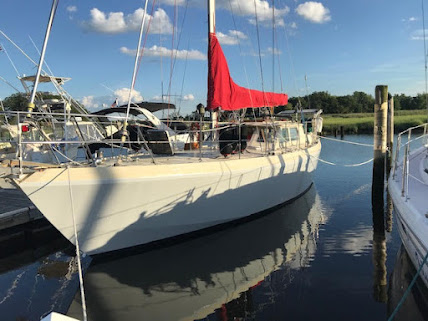
Yesterday he cast off lines at the yacht club in St. John Newfoundland, and headed for Nuuk, Greenland.
Time and tide wait for no one, so he headed out in difficult conditions. As of 21:15 GMT Felicity was making 2.7 kts at a heading of 57.3 true with the wind 60 degrees off the port bow at 22 kts. The water temperature in the Labrador Sea now is about 42 degrees.