


Egbert 2
-
Here was the first installment. Agent Gaile has shared these, which do a
great job of completing the portrait of this freighter. She took these
photos in C...
6 hours ago
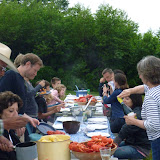 26 for dinner at our Stones Point reunion 2011! Click on the photo for the whole slide show!
 |
| Somandshjemmet - showers & WiFi |
 Aasiaat, Greenland is on Baffin Bay, north of the Labrador Sea. It is north of Nuuk - the largest settlement. Formerly Danish, it is now autonomous - with Danish support, as the name of Seaman's house shows. In the second shot Issuma is against the bulkhead. Aasiaat's tides are moderate - today's 2.3 meters is about as high as it gets. (We had more than that today on the Muscongus Bay.)

 |
| Cartwright harbor - Labrador |
wo weeks ago, as we sailed into Cartwright Harbor Two weeks ago, as we sailed into Cartwright Harbor (pictured). A few hundred metres away from the dock, we started lowering sails and prepared to start the engine to motor onto the dock. The engine oil level was unexpectedly high. The oil was black, so I figured the fuel pump had leaked fuel into the crankcase, as I saw no signs of water. We started the engine and motored onto the dock.
After shutting down the motor, the oil was checked again, and now it looked like a chocolate milkshake, a sure indication that water was mixed into the oil. The oil was changed and the filter washed out with fuel. I'd bought a dozen "compatible" oil filters at the auto parts store in Rimouski a month ago and hadn't used any of them yet, so hadn't yet realized that none of thembe fit the engine. So, I needed to find the source of the water getting into the fuel and change the oil and filter enough times to clear all the water out (when water mixed with antifreeze mixes with the oil, the antifreeze prevents the oil from lubricating the bearings and it soon destroys the engine if the engine is continued to be run). No suitable oil filters were available in Cartwright.
The engine in Issuma is made by John Deere, but marinized (mostly this means adding a heat exchanger and a seawater pump so seawater cools the antifreeze/water that the engine is cooled with) by Baudouin. As Baudouin is in France, with only one dealer in Canada (in Montreal), versus John Deere being the real manufacturer of the engine and having many dealers all over the place, including Newfoundland, I figured they would be the best place to have a new oil cooler and head gasket (the two possible ways for the engine water/antifreeze to get into the oil) sent from.
I called up the John Deere dealer from the payphone in the store (no cellular service here) and ordered the parts. The John Deere dealer needed the serial number of the engine to get the correct oil cooler. Unfortunately, when Baudouin marinized the engine, they REMOVED the serial number plate from the engine, putting their own serial number plate in its place. I had a service manual for the engine, which said there were three possible oil coolers, and had pictures of each type. I emailed a copy of the relevant page of the service manual to the John Deere dealer, and he thought he could get the right one based on that.
The oil filters took six days to arrive, as the dealer thought they would be best shipped to Goose Bay by air and then transferred to something else to get to Cartwright. After a few days, everyone in Cartwright knew we were at the dock, waiting for parts, and people helped us out. Innu Mikkun airlines got the parts and put them on a charter flight that was going to Cartwright. Then I was able to change the oil and filter several times and determine that the problem was the oil cooler.
The oil cooler, which had to be sent from Ontario, arrived after several more days. Unfortunately, it was not the same type as the old one, so didn't fit. Knowing there was a machine shop in Goose Bay (a 5 hour drive), I hitchhiked to Goose Bay, got a part modified at the machine shop the next day, and hitchhiked back. Several more hours of installing the oil cooler and replacing hoses (they needed to change size to work with the new oil cooler) and the engine was running properly.(pictured). A few hundred metres away from the dock, we started lowering sails and prepared to start the engine to motor onto the dock. The engine oil level was unexpectedly high. The oil was black, so I figured the fuel pump had leaked fuel into the crankcase, as I saw no signs of water. We started the engine and motored onto the dock.
After shutting down the motor, the oil was checked again, and now it looked like a chocolate milkshake, a sure indication that water was mixed into the oil. The oil was changed and the filter washed out with fuel. I'd bought a dozen "compatible" oil filters at the auto parts store in Rimouski a month ago and hadn't used any of them yet, so hadn't yet realized that none of thembe fit the engine. So, I needed to find the source of the water getting into the fuel and change the oil and filter enough times to clear all the water out (when water mixed with antifreeze mixes with the oil, the antifreeze prevents the oil from lubricating the bearings and it soon destroys the engine if the engine is continued to be run). No suitable oil filters were available in Cartwright.
The engine in Issuma is made by John Deere, but marinized (mostly this means adding a heat exchanger and a seawater pump so seawater cools the antifreeze/water that the engine is cooled with) by Baudouin. As Baudouin is in France, with only one dealer in Canada (in Montreal), versus John Deere being the real manufacturer of the engine and having many dealers all over the place, including Newfoundland, I figured they would be the best place to have a new oil cooler and head gasket (the two possible ways for the engine water/antifreeze to get into the oil) sent from.
I called up the John Deere dealer from the payphone in the store (no cellular service here) and ordered the parts. The John Deere dealer needed the serial number of the engine to get the correct oil cooler. Unfortunately, when Baudouin marinized the engine, they REMOVED the serial number plate from the engine, putting their own serial number plate in its place. I had a service manual for the engine, which said there were three possible oil coolers, and had pictures of each type. I emailed a copy of the relevant page of the service manual to the John Deere dealer, and he thought he could get the right one based on that.
The oil filters took six days to arrive, as the dealer thought they would be best shipped to Goose Bay by air and then transferred to something else to get to Cartwright. After a few days, everyone in Cartwright knew we were at the dock, waiting for parts, and people helped us out. Innu Mikkun airlines got the parts and put them on a charter flight that was going to Cartwright. Then I was able to change the oil and filter several times and determine that the problem was the oil cooler.
The oil cooler, which had to be sent from Ontario, arrived after several more days. Unfortunately, it was not the same type as the old one, so didn't fit. Knowing there was a machine shop in Goose Bay (a 5 hour drive), I hitchhiked to Goose Bay, got a part modified at the machine shop the next day, and hitchhiked back. Several more hours of installing the oil cooler and replacing hoses (they needed to change size to work with the new oil cooler) and the engine was running properly.


 "Figure 1. Arctic sea ice extent on July 17, 2011 was 7.56 million square kilometers (2.92 million square miles). The orange line shows the 1979 to 2000 median extent for that day. The black cross indicates the geographic North Pole."

We left Black Tickle on a quiet morning, motoring out of the still harbor and away from the coast until the wind picked up enough to sail. The piece of ice in the photo was fairly close to the shore.
I'd been paying a lot of attention to the weather forecasts. Computer programs made their guesses, the National Weather Service made their guesses, Environment Canada made their guesses, and I looked at all these and made my guesses. We were all wrong :).
What was expected to be a brisk reaching wind turned into a mere slog dead to windward in F4-6 seas for a little over a day. We dodged several growlers and bergy bits in the intermittent rain and fog. The forecasts had now changed to be another day of headwinds to 30 knots. We were sailing against the south-flowing Labrador current, and progress was slow when, during a gybe, the inner jib (trinquette) refused to come across.
A quick check up forward showed the stay was no longer attached to the mast. We got the other sails down so we would be heading downwind, and then brought the stay and sail (it was a roller-reefed sail) onto the deck. It seemed that the cotter pin that holds the clevis pin that holds the stay (wire) in place had sheared off. We got the sail off and cleaned up the deck, then changed course and sailed and motorsailed towards Cartwright, which was only about 130 miles back from where we were.
As we got closer to the coast, the wind became quite favorable, the sun came out and we had a pleasant sail to within a few hundred metres of the dock. There we went to start the engine to motor onto the dock, and that began the John Deere Saga, which is the topic of another post.

from Paul Cayard, July 21, 2011Our team has been training on our AC45 here in Valencia for a week now. I went out yesterday and joined them onboard in 18-22 knots of wind. It was quite a ride! 27 knots was the top speed of the day and 20-24 knots is normal downwind speed in those conditions.Our coach, Andrew Palfrey, had set up a course and the crew took the boat through its paces. The level of physical activity onboard is like nothing the America's Cup has ever seen. The races last 30 minutes and the heart rate for most of the 5 man crew is over 150bpm for that entire period with peaks of 175. They actually wear heart rate monitors so the team's trainer, Pete Cunningham, can log their physical capabilities and stresses. Recovery from these races will be paramount and the coach boat comes alongside after the session with energy drinks and protein bars. The crew eat "gel" throughout the day.The crew on the day included Skipper - Terry Hutchinson (USA), Mainsheet trim - Sean Clarkson (NZL), Camber/Trim Kevin Hall (USA), Headsail trim - Morgan Trubovich (NZL), Bow - Julien Cressant (FRA). I was the "6th" man which is the guest. Terry let me steer on the the way back to the harbor which was fun. 27 knots.I look at all this and wish I was 20 years younger. It looks like so much fun and I love that it is so physical. Growing up, I loved basketball as much as I loved sailing. But I ran out of vertical so stuck with the sailing. In sailing, I always loved the Star on a windy day because it is so physically challenging. It looks to me like catamaran sailing in the America's Cup is going to bring sailing into the realm of a truly physical sport.Our training continues through Tuesday, then the boat and its four containers and tender get packed up and trucked to Cascais (Portugal) for the first America's Cup World Series event from August 6- 14.Paul


