Thursday, August 19, 2021

Portland to Belfast - aboard Caleru

 August 17-18 I joined the crew to deliver Ralph and Hannah Wolf's Whitbee 42 to Belfast, Maine.  I went aboard in Portland.  Landmarks of note were Seguin Island, Georges Harbor/Allen Island, Whitehead Light/Muscle Ridge Channel, Southern Island/Tenants Harbor. and the Owls Head light just before Rockland harbor.

Georges Harbor is where Englishmen first landed in Maine, commemorated on the tercentennial in 1905 by a granite cross and a big ceremony which treated the voyage of George Weymouth's Archangel as the state's founding event.  Today it is a beautifully composed scene - Betsy and Andrew Wyeth's house on Benner Island and the lobstermen's wharf, old sail loft, houses and cottages of the Allen Island Sea Station - served by the namesake of Weymouth's Archangel. 

I slept on a cockpit bench and awoke to first light and the low rumble of a lobsterman headed south past the seal ledges between Allen and Burnt islands.

Harvey and Ralph were amiable crewmates.  I'm sure our work will be appreciated by Hannah and the kids - after whom CaLeRu is named.

Seguin Island


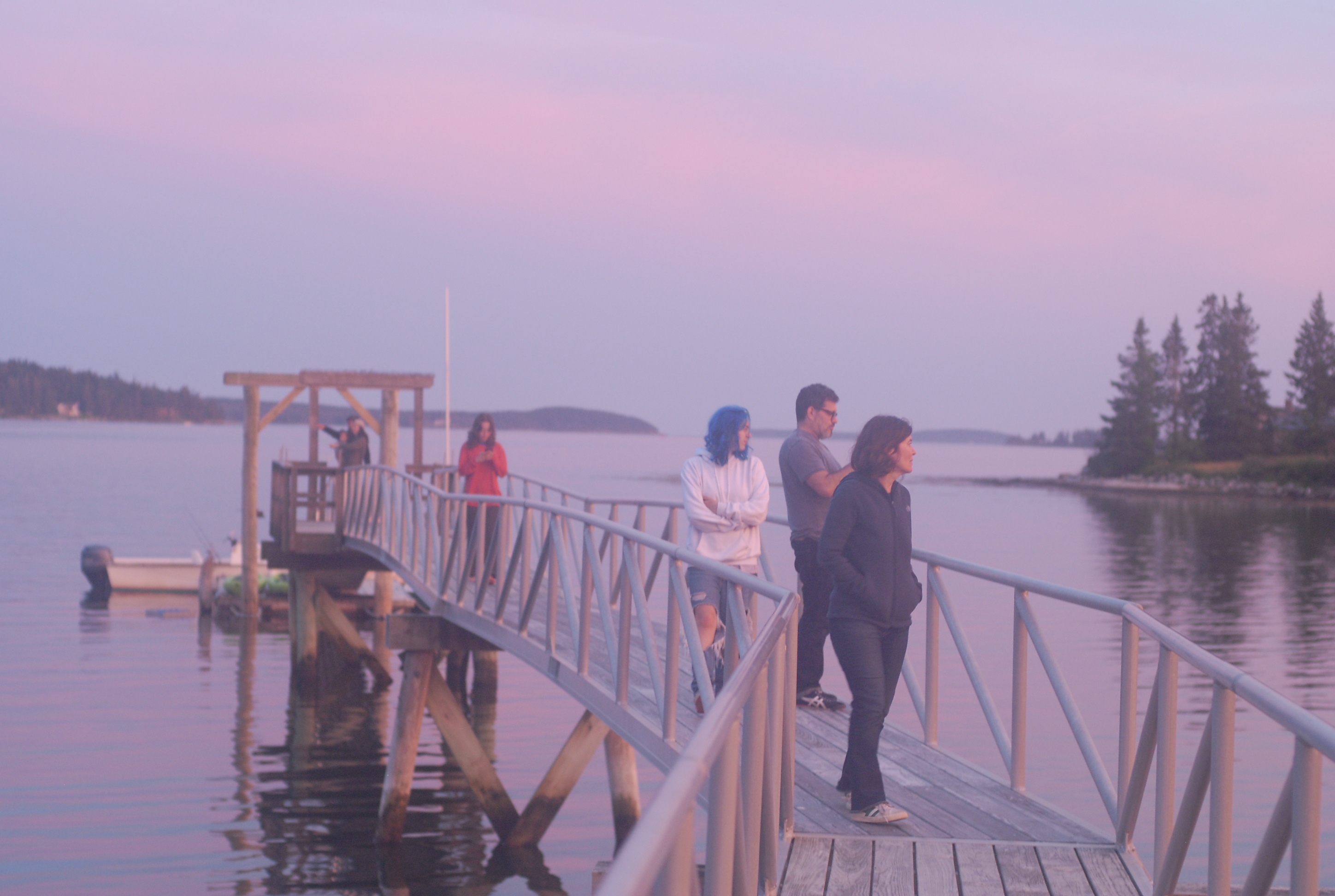
Allen Island at dusk

Whitehead Island Light - Muscle Ridge Channel

Motivation

Southern Island/Tenants Harbor


Georges Harbor
First light


Tuesday, August 10, 2021

Saturday, July 31, 2021

Maine History Mural - by Christopher Cart

 We got to know Christopher Cart's work when one of his paintings of dancers was for sale at the awesom Harbor Square Gallery in Rockland, Maine.  Often of dancers, his paintings are powerful portraits.  We let our favorite slip past to our regret.  So when automobile repairs drove us to Augusta we stopped at the Kennebec  Capital Justice Center where the entrance to an auditorium is framed by impressive murals of scenes from Maine's history.

My favorite is the ice harvesters - because I know from my Peace Corps years that some of that Penobscot River ice made it to the `ais haus' on the Bombay waterfront - now a bus terminal of the same name.


Tuesday, July 27, 2021

Friday, July 23, 2021

Greek traditional wooden boat builders a dwindling craft


Greek traditional wooden boat builders a dwindling craft
by Elena Becatoros

DRAKAIOI, Greece (AP) — On the forested slopes of an island mountain, early morning mist swirling around its peak, the unmistakable form of a traditional Greek wooden boat emerges: a caique, or kaiki, the likes of which has sailed these seas for hundreds of years.

Each beam of wood, each plank, has been felled, trimmed and shaped by one man alone, hauled and nailed into place using techniques handed down through generations, from father to son, uncle to nephew. But the current generation could be the last.

Wooden boats are an integral part of the Greek landscape, adorning tourist brochures, postcards and countless holiday snaps. They have been sailing across Greece for centuries, used as fishing boats, to transport cargo, livestock and passengers and as pleasure craft.

But the art of designing and building these vessels, done entirely by hand, is under threat. Fewer people order wooden boats since plastic and fiberglass ones are cheaper to maintain. And young people aren’t as interested in joining a profession that requires years of apprenticeship, is physically and mentally draining and has an uncertain future.

KEEP READING