
TUE NIGHT
SE winds 15 to 20 kt, increasing to 20 to 25 kt
after midnight. Gusts up to 35 kt. Seas 2 to 4 ft. Rain. Vsby
1 to 3 nm.
NOAA - Western Long island Sound Marine forecst
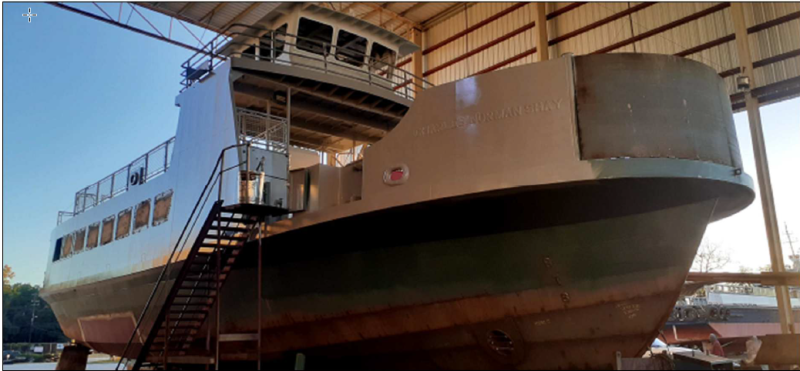
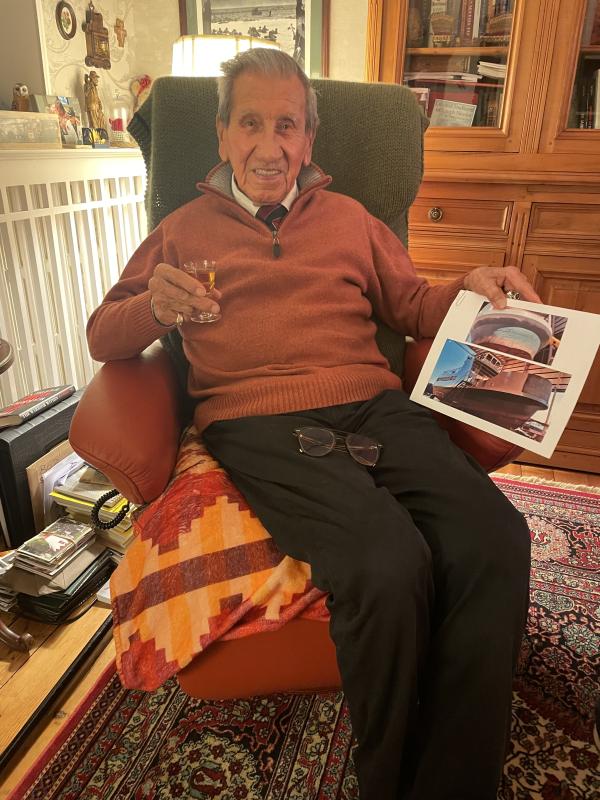
ROCKLAND — The new Maine State Ferry Service vessel being built to serve Matinicus Isle will be named the Charles Norman Shay after the heroic Maine veteran and member of the Penobscot Nation who served as a combat medic during the D-Day invasion.
Shay was 19 years old and living on Indian Island when he was drafted to serve in World War II. He served as a combat medic during the D-Day invasion and saved many lives on Omaha Beach. Shay is believed to be the last living Native American who stormed the beaches of Normandy. His heroic efforts on D-Day earned him the Silver Star and the French Legion of Honor. He also served in the Battle of the Bulge. After World War II, he served in Korea.
Shay is 99 years old and living in France. He will turn 100 in June.
The route is currently being served by the Everett Libby – a ferry that dates to the 1960s and needs to be replaced, according to MDOT. In August 2022, MaineDOT awarded the ferry vessel construction contract to Steiner Shipyard in Bayou La Batre, Alabama. Construction began in November 2022. This new diesel ferry will be 104 feet long. It will have the capacity to carry 149 passengers and seven cars. The cost of construction is approximately $10 million.
Selecting a name for a new Maine State Ferry Service vessel is done through consultation between the MSFS Advisory Board and the Commissioner of the Maine Department of Transportation, according to MDOT, in a news release. Earlier this year, the residents of Matinicus recommended to the MSFS Advisory Board that the island's new vessel be named after Shay. Members of the Matinicus community wanted to recognize the Penobscots because of their presence on the island for centuries prior to the arrival of European settlers. Shay has deep family roots in the areas that will be served by this vessel. This will be the first MSFS vessel named for a Native American.
Earlier this week, the Maine Department of Transportation contacted Shay in France to update him on the construction of the vessel that will bear his name.
The Charles Norman Shay is expected to arrive in Rockland in the spring.
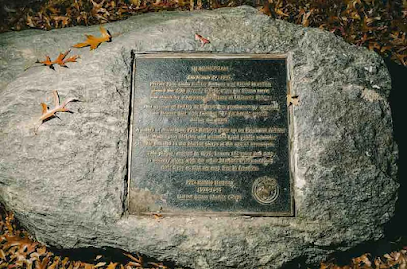

The Tribute in Bennett Park to a Young Soldier - by Joe Nocera The Free Press November 11, 2023
My neighborhood in upper Manhattan surrounds a small, sweet park—Bennett Park, it’s called—that marks the highest natural point in New York City. Long ago, it was the site of Fort Washington, which the Continental Army built in the summer of 1776 only to have it captured by the British until the end of the Revolutionary War. Today, the fort’s walls are partially outlined by cobblestones, and dogs frolic around a centuries-old cannon.
In 1996 the New York City Department of Parks & Recreation added another war memorial in Bennett Park, this one dedicated to the memory of a man—a kid, really—who had grown up in the neighborhood and had been killed during World War II. His name was Emilio Barbosa. The inscription said that he was a native of Nicaragua who had lived on Pinehurst Avenue, a street that borders the west side of the park. At 17 he joined the Marines and spent the next two years manning a 20mm gun turret on the USS Nevada, fighting first at Normandy Beach and then in the Pacific theater. He died at the age of 19, when a Japanese kamikaze pilot flew into the Nevada as she bombarded Okinawa.
Barbosa’s small plaque, low to the ground and under a tree, is easy to miss. But I’ve found myself lingering over it from time to time, wondering about the man it honors—imagining, for instance, how terrifying it must have been as that Japanese plane closed in on him. My father also served in the Pacific, and decades later, when he could finally bring himself to talk about it, he said that the experience of watching a kamikaze pilot dive toward his ship had instilled in him a profound belief in God.
I’ve visited the Normandy American Cemetery in France and the Long Island National Cemetery, where the endless rows of unadorned white gravestones can be overwhelming—and can raise those same kinds of questions. How had these men lived? How did they die? What might they have done with their lives if they had survived the horrors of war?
Maybe it’s because Emilio Barbosa isn’t among the tens of thousands of soldiers buried in one of those massive national cemeteries, with nothing but a name on a gravestone—maybe it’s because his little memorial offers such a poignant outline of one soldier’s short life—that I felt I wanted to know more. And in learning more, I thought that on this Veterans Day, we might better appreciate the sacrifice he—and all the other soldiers who died in America’s wars—made for their country.
One thing I’d always wondered is when Emilio came to America. None of his descendants I spoke to knew the precise date, but the internet did—January 1929, when he was three years old. He arrived in New York from Managua with his parents and two older brothers. Why had the Barbosas immigrated? Emilio’s descendants definitely knew the answer to that: his father Jose, a prominent journalist, was fleeing the wrath of Anastasio Somoza, about whom he’d written critically. Somoza wasn’t yet Nicaragua’s dictator, but he had already amassed power and was using it to crush critics.
“He had been an intellectual in Nicaragua,” Jose’s great-granddaughter Magdalena told me about her ancestor. “Once he got here, though, he was a longshoreman.” This, of course, is the classic immigrant’s tale: you sacrifice so that your children can have a better life in America. And they did, moving eventually to a large apartment on Pinehurst Avenue in Washington Heights, where Emilio and his two older brothers went to public school, listened to pop songs on the radio, played baseball—and spoke mostly English to each other. Like many immigrants, their most fervent desire was to join the melting pot, to be as American as they could possibly be. Jose became known as Joseph. One by one, they gained their citizenship. And when the U.S. entered World War II, Jose’s three boys didn’t wait to be drafted; they immediately signed up. Joseph Jr., the oldest, joined the Army; Benjamin, one year younger, chose the Navy; and Emilio enlisted in the Marines.
Emilio was described to me as a happy-go-lucky kid who was a superb baseball player, far better than his older brothers, whom he worshipped, and who looked after him as they grew up. They tried to talk him out of enlisting—he had a year to go before he was eligible for the draft—but he wouldn’t listen. If his big brothers were going to fight for their adopted country, then so was he.


I've had Cassius on North River 2 since he was three months old - July 4, 2020! Sometimes he likes it, sometimes he wants to go on the "fast boat, not the sailboat". But I'm hopeful that yesterday was a turning point. He got to steer. Taking command increases confidence. A soft steady breeze after days of rain from a passing hurricane Ophelia.
With Taisy at his side Cassius rose to the occasion.
- GWC


Risk is fickle. As nice Jewish girls from Brooklyn know.
Ask Liza Mills.
On Mills’s second big wall she found herself partnering with Lynn Hill, a dear friend from the Gunks, who, after moving from New York to Yosemite, passed the mantle of top Gunks woman climber to Mills. Still, Mills recalls, “When we’d walk around Camp 4, climbers looked at me, like, Huh? Who’s that?”
“Meanwhile everyone knew Lynn. She was climbing’s rock star.”
Their route, El Cap’s West Face (VI 5.11c, 20 pitches), should have been a stroll for the duo. But as Mills knew from her childhood in Brooklyn: Risk is everywhere.
Example: Hydration backpacks.
Mills explains, “Neither of us had ever used one and couldn’t tell how much water was left in them. It was a super hot day and by the tenth pitch, to our horror, we ran out of water.”
Hill adds, “But with half the climb left, we had to keep going.”

If we are to devise an enlightened plan for human activity in the Arctic, we needa ore particularized understanding of the land itself - not a more refined mathematical knowledge but a deeper understanding of its nature, as if it were, itself, another sort of civilization we had to reach some agreement with. I would draw you, therefore, back to the concrete dimensions of the land and to what they precipitate; simply to walk across the tundra; to watch the wind stirring a little in the leaves of dwarf birch and willows; to hear the hoof-clacket of migrating caribou. Imagine your ear against the loom of a kayak paddle in the Beaufort Sea, hearing the long, quivering tremolo voice of the bearded seal. Or feeling the surgical sharpness of an Eskimo's obsidian tool under the stroke of your finger.

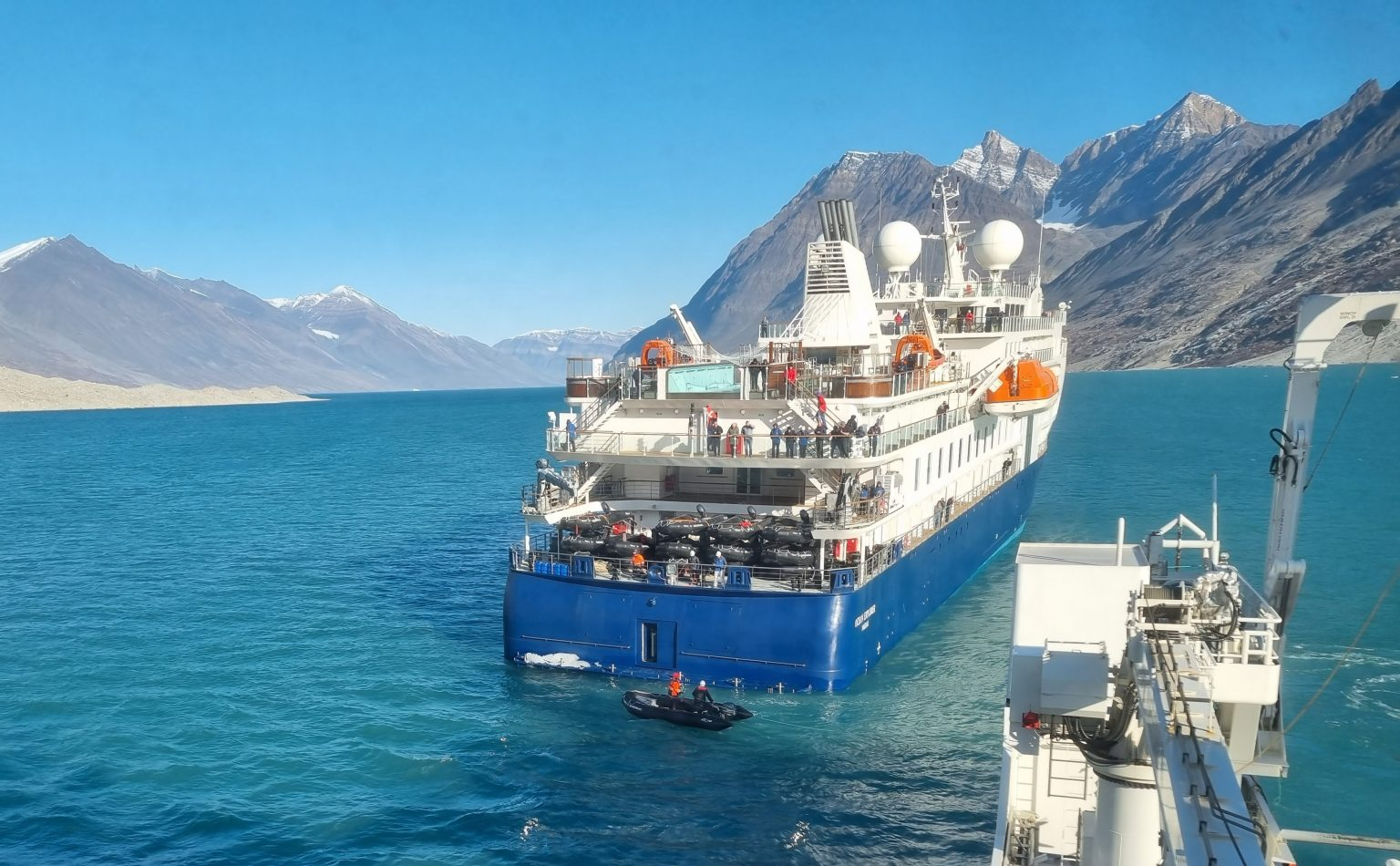
“We’re really happy that it went so well and that the passengers and crew of the ship can now see an end to the difficult situation they’ve been in for the last few days,” said Captain Brian Jensen, Commander of Denmark’s Joint Arctic Command. “Regardless that no one was in direct danger, I understand if being stuck in such a deserted area with no possibility to move forward has been uncomfortable.”
Initial attempts to refloat the Ocean Explorer at high tide were unsuccessful, prompting the assistance of the Knud Rasmussen, an offshore patrol vessel with the Royal Danish Navy, which was located 1,200 nautical miles away. The Knud Rasmussen was expected to arrive at the scene Friday evening, but has now been stood down.


